
Secret CISO 9/15: CVE-2026-76461 Exploited, 190 Leak-Site Victims, Stolen LLM Pool, GitLab CVSS 10
Cisco says CVE-2026-76461 is actively exploited, and it is already in CISA KEV. Leak-site monitors logged 190 new ransomware victim posts last week, while a weird new “stolen LLM gateway pool” pattern shows agents reselling access at scale.
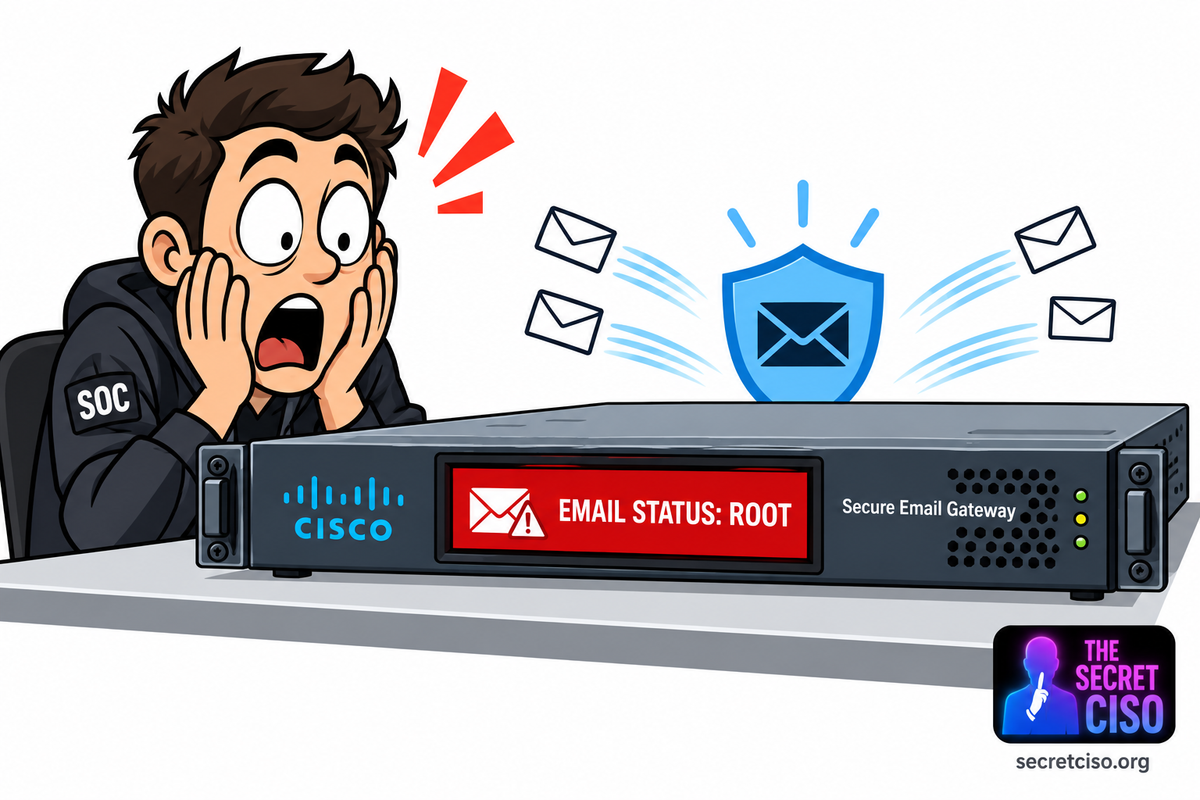
The quiet part got loud: “email security appliances” and “AI gateways” both turned into the same thing this week, high privilege choke points with internet-facing regret baked in.
Today's Top 5
- Cisco SEG popping root: Cisco says CVE-2026-76461 is being actively exploited, and the bug sits in the place you least want a parser bug to live. The patch story has a sharp edge for anyone running AsyncOS. Source
- 190 ransomware victim posts: Leak-site telemetry logged 190 new double-extortion listings in seven days, with newer crews gaining share. If your IR plan assumes “big game hunting only,” today’s data disagrees. Source
- Stolen LLM pool at scale: A honeypot saw an agent aggregating roughly 379 upstream LLM resale channels behind a New-API instance, then iterating like it was doing QA. It is basically credential stuffing, but for inference. Source
- GitLab file-read perfect 10: CVE-2026-85706 is a path traversal that can let an unauthenticated attacker read arbitrary files from GitLab, depending on conditions. The scanning pressure after disclosure is the real headline. Source
- Care providers on leak sites: Leak-site monitors saw multiple extortion crews naming healthcare-related orgs over a short window. Some will be noise, some will become breach letters, and defenders rarely know which until it is too late. Source
Why today matters: The pattern is “control planes and gateways,” not endpoints. Attackers are targeting the systems that sit between you and everything else: email inspection, repo APIs, BI layers, and now LLM access brokers. If your org still treats these as “tools” instead of tier-0 assets, you are giving intruders the shortest path to root and to data.
Okay, let’s get into the receipts.
Data Breaches

- Automobile Club of Southern California breach listing (vendor-linked): A new breach-notification tracker entry flags Automobile Club of Southern California as a third-party vendor breach via DanubeNet (Driving School Solutions). Treat this as an early-warning signal for downstream member-targeted phishing. Source: Breach Letter
- DocketWise: new public settlement site for 2025 data incident: A settlement website published September 15, 2026 describes a data incident tied to credentials used to clone a third-party partner repository used in a migration pipeline. If you are a SaaS vendor, this is the case study for “repo access equals customer data.” Source: DocketWiseSettlement.com
- University of San Francisco named by The Gentlemen (claim): Leak-site reporting shows The Gentlemen listing the University of San Francisco as a victim (unverified by the org). It is a reminder that higher ed is still being treated as a data-rich soft target. Source: f4n6 Security Feed
- “Indic” added to The Gentlemen leak site (claim): A CTI tracker shows Indic added on September 14, 2026 as part of a double-extortion listing. Even if the victim name is thin, the operational tempo of this crew is not. Source: CTIWatch
Security Research

- Cisco: SEG SQL injection is actively exploited: Cisco’s advisory for CVE-2026-76461 describes a SQL injection that can enable command execution as root in Cisco Secure Email Gateway. If SEG is in your inbound mail path, assume the blast radius includes credential theft and BEC staging. Source: Cisco
- Canada’s Cyber Centre confirms KEV context for Cisco SEG: The Canadian Centre for Cyber Security notes Cisco’s active exploitation statement and that CISA added CVE-2026-76461 to KEV. This is the “no excuses” signal for federal-adjacent shops and anyone copying their playbook. Source: Canadian Centre for Cyber Security
- GitLab path traversal details (GHSA): The GitHub Advisory Database entry for CVE-2026-85706 lays out affected version ranges and the file-read impact through the repository commits API. If your GitLab hosts secrets, the urgency is not theoretical. Source: GitHub Advisory Database
- Metabase exploitation tracking via Check Point advisory: Check Point’s advisory references Metabase SQL injection CVE-2026-72898 as attack information, aligning with continued BI-layer targeting. If Metabase touches prod databases, it is a pivot machine. Source: Check Point
- “Stolen inference supply chain” in the wild: SANS Stormcast spotlights an observed pattern where an agent harvests and re-serves LLM access via poorly secured gateways, scaling like an automated broker. CISOs should treat LLM access keys like cloud keys, because attackers already do. Source: SANS ISC
Top CVEs

- CVE-2026-76461: Cisco Secure Email Gateway SQL injection that can lead to command execution as root, with active exploitation reported. Prioritize upgrades and confirm management plane exposure, because “email security” appliances are often over-trusted internally. Source
- CVE-2026-85706: GitLab CE/EE path traversal that can allow unauthenticated arbitrary file reads under certain conditions, impacting secrets, config, and tokens. Patch to fixed versions and hunt for odd commits API access patterns immediately after. Source
- CVE-2026-81963: Windows Update Stack elevation of privilege, one of Microsoft’s September 2026 zero-days called out as already exploited. Treat it as post-compromise privilege escalation and check your telemetry for suspicious local elevation chains. Source
- CVE-2026-85880: Windows ALPC elevation of privilege, also flagged as exploited in Microsoft’s September 2026 release coverage. This is the kind of “small local” bug attackers love because it turns a foothold into SYSTEM. Source
- CVE-2026-72898: Metabase unauthenticated SQL injection enabling admin takeover through password reset flows, with exploitation reported and prior KEV inclusion noted by multiple defenders. If Metabase is internet reachable, assume someone already tried it. Source
Podcasts & Talks

- SANS Stormcast (Sep 14, 2026): Self-Expanding Stolen LLM Gateways: This episode is worth sending to your AI product owner because it shows real attacker automation around resold inference access, not just “prompt injection” theory. Listen: SANS ISC
- Risky Business Features (Sep 11, 2026): Hunting software supply chain malware: A practical discussion that maps cleanly to what your SOC can actually instrument, especially if your SBOM program is mostly a slide deck. Listen: Podcast Rex
Final Words
The underlying pattern today is attackers choosing the shortest trust path, not the loudest exploit. Email gateways, repo APIs, BI tools, and LLM access brokers all sit at the intersection of “internet reachable” and “implicitly trusted.” That changes the threat model: your choke points are now your crown jewels, and most org charts still do not reflect that uncomfortable reality.
This week, do three things:
- Patch or hotfix Cisco Secure Email Gateway for CVE-2026-76461, then validate with an external scan that no unintended management interfaces are exposed.
- Upgrade GitLab to a fixed release for CVE-2026-85706 and rotate any secrets that could be read from server-side files (tokens, keys, config).
- Inventory and lock down Metabase instances, patch for CVE-2026-72898, and ensure the reset-password endpoint is not reachable from the public internet.
Your turn: If your email security gateway got popped tomorrow, do you have a tested playbook for what credentials and trust paths it can silently hand an attacker? Hit reply with your one-sentence answer, or drop a comment on the web version. I read every reply.
Know someone who still treats the email gateway as “set and forget”? Forward them this issue, especially the CVE-2026-76461 item, because root on the mail choke point is where bad weeks start. If you got this forwarded, subscribe free at secretciso.org.
Stay vigilant, stay informed, and see you in the next edition of Secret CISO!