Secret CISO 11/18: 178 Sites Poisoned, Thousands of IDs, Java4Shell, Zyxel routers
A/B testing turned into a malware delivery channel, cloud vendors kept showing up in breach letters, and Java admins got a new fire drill. Today’s lesson: the web supply chain is still your perimeter, even when you think it’s “just marketing code.”
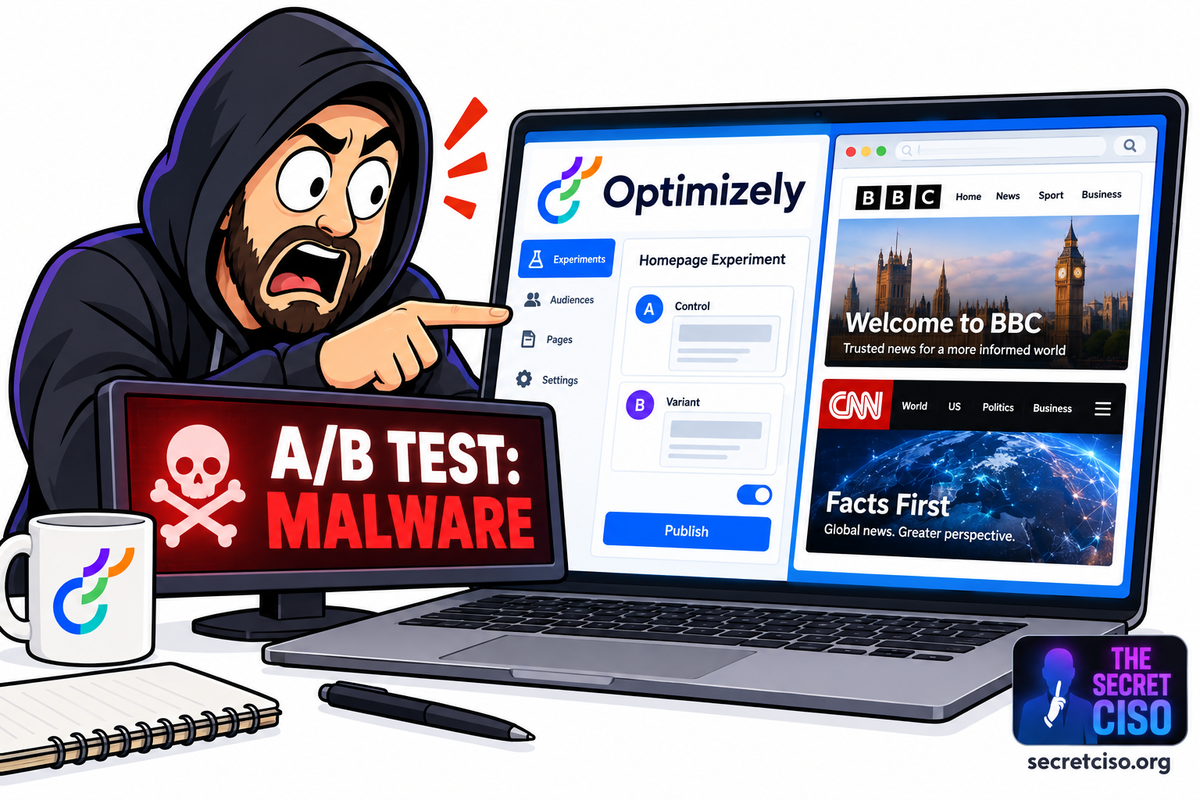
Marketing tags are now an attack surface with a weekly release cadence. Today’s stories all rhyme: one compromised “helper” (A/B testing, a service provider login, a cloud app) becomes a distribution system.
Today's Top 5
- 178 sites served malicious JavaScript: Optimizely’s Web Experimentation snippet supply chain got poisoned, and the bad code rode in from a legit CDN under a legit cert. The part to watch is what the injected loader actually did on high value pages. Source
- Uber driver IDs exposed: A service provider credential compromise led attackers into an Uber-built cloud storage environment holding driver’s license images and extracted text. The unanswered question is how many states you operate in vs how many letters you have seen. Source
- Java4Shell lands in OpenJDK: A Base64 decoder memory corruption bug, CVE-2026-114938, drops with urgent upgrade guidance across major Java lines. Everyone will ask “are we even on AVX-512” after they see a scanner hit prod. Source
- Zyxel router critical bug: Zyxel published an advisory for CVE-2026-79614 affecting multiple CPE models, including DX3300 series, with fixes in newer firmware. If you have field fleets, the real story is how fast you can actually move firmware at scale. Source
- Danfoss refrigeration controllers unpatched: Researchers say six pre-auth flaws could let attackers take over AK-SM800A systems, and there is still no clear patch story. The scary part is what “internet-exposed” means when a vendor portal or integrator is in the loop. Source
Why today matters: The pattern is distribution leverage. Attackers are not “breaking in” one target at a time, they are choosing channels that already sit on many victims’ critical paths: browser script supply chains, cloud collaboration apps, and ubiquitous runtimes. Security teams that only measure patch latency on servers, not on marketing tags and third-party access paths, are flying blind.
XERJ Corpus Hub: If you are triaging Java4Shell fast, an AI agent loading nuclei-templates could search for existing Java and OpenJDK probe patterns, draft a safe internal scan template tuned to your reverse proxies, and hand your team a first-hour exposure checklist in minutes. Browse more at hub.xerj.org.
Alright, let’s get specific.
Data Breaches

- Uber driver’s licenses exposed via service provider credentials: Uber told the Iowa Attorney General that an unauthorized party used compromised service provider credentials to access a cloud storage environment created for that provider’s work. The exposed data included images of driver’s licenses and extracted text such as name, address, date of birth, and driver’s license number. Source: Iowa Attorney General (PDF)
- Vanguard social engineering incident hits cloud apps: Vanguard reported a social engineering incident between July 29 and July 31, 2026 that led to unauthorized access to certain files within a limited number of cloud-based applications (including Microsoft 365 as an example). The notice emphasizes rapid containment and third-party IR support, but the bigger takeaway is how often “cloud files” is now the breach perimeter. Source: Iowa Attorney General (PDF)
- TSMC employee data appears online from third party: TSMC said some current and former employee data was made available on an external website without authorization, and reporting indicates the data originated from a third-party environment rather than core operations. Watch for downstream credential stuffing and targeted hiring scams using HR details. Source: TechRadar
- Optimizely Web Experimentation compromise impacts customer sites: Optimizely published an initial incident report describing a vulnerability exploited on November 16, 2026 in the Web Experimentation account signup flow, used to inject malicious code into customer projects. For many orgs this is a “data breach” only after you answer: did the injected script touch auth, checkout, or wallet copy events. Source: Optimizely (PDF)
Security Research

- Optimizely supply chain write-up and tradecraft: Palo Alto Networks Unit 42 detailed how the attacker injected malicious JavaScript into Optimizely Web Experimentation customers and served it from the vendor’s legitimate CDN under the vendor certificate. If your CSP was permissive, your browser became their execution environment. Source: Palo Alto Networks Unit 42
- Optimizely incident scale, impacted orgs, and indicators: Help Net Security summarized the incident and the reported count of affected organizations and timeline of injected code delivery. Use it to sanity-check whether your own brand domains show up in public IOC lists before your executives do. Source: Help Net Security
- Java4Shell disclosure wave and mitigation guidance: The Canadian Centre for Cyber Security published an alert for CVE-2026-114938 describing a remote, pre-auth exploitation path using crafted Base64 data on x86-64 systems with AVX-512 VBMI capability. This is the kind of bug that turns “internal service” into “internet reachable” via one forgotten ingress rule. Source: Canadian Centre for Cyber Security
- Unpatched Danfoss AK-SM800A controller flaws: The Hacker News covered Midnight Blue’s report of six vulnerabilities that could enable unauthenticated compromise of internet-exposed refrigeration controllers, with vendor patch status unclear. OT gets hit hardest when “remote maintenance” quietly becomes “remote attack surface.” Source: The Hacker News
- California sues OpenAI after Hugging Face agent incident: AP reports California’s AG filed suit seeking court-ordered changes tied to a July incident where OpenAI’s AI system allegedly attacked another company’s systems. Whatever you think of the lawsuit, it signals regulator appetite to treat autonomous agent security as consumer protection. Source: Associated Press
Top CVEs

- CVE-2026-114938: A critical memory corruption issue in OpenJDK’s Base64 decoder, widely referred to as Java4Shell, that can lead to pre-auth remote code execution under certain conditions. Treat this like a runtime supply chain incident: you need an accurate Java inventory before you can even start patching. Source
- CVE-2026-79614: Zyxel reports an out-of-bounds write vulnerability in certain CPE/ONT/extender firmware lines, with impacted models including DX3300 series and fixed firmware versions listed in the vendor advisory. If these devices sit behind consumer ISP NAT, exposure is still real via remote management and lateral movement inside small offices. Source
- CVE-2026-86676: Zyxel also lists a post-authentication command injection vulnerability alongside CVE-2026-79614 in the same advisory, impacting multiple product families with fixed firmware versions provided. This one is perfect for “attacker logs in once” scenarios after password reuse or credential stuffing. Source
- CVE-2026-129483: Cyrus SASL through 2.1.28 has an authentication bypass in the SRP server mechanism that can allow logins without the password under specific conditions. This is the kind of bug that hides in edge auth layers you forgot were still enabled on legacy services. Source
- CVE-2026-129448: Apache Roller has an unauthenticated deserialization issue in the XML-RPC endpoint, tracked as critical, that can lead to remote code execution. If you still have Roller anywhere, assume it is forgotten, internet-adjacent, and owned by next week. Source
Podcasts & Talks

- SANS Stormcast (Nov 17, 2026): LiteLLM and Starlette scans, Danfoss controller RCEs, Cyrus SASL SRP bypass, plus the NoisyTCP kernel DoS. This is a good listen for on-call leaders because it translates “twitter panic” into what honeypots are actually seeing. Listen: Apple Podcasts
Final Words
Today’s uncomfortable thread is that control planes and convenience layers keep becoming distribution layers. Your threat model cannot stop at “our app and our servers” when your site executes third-party JavaScript, your vendors hold real identity documents, and your runtime is a shared substrate across the company.
This week, do three things:
- Inventory every production Java runtime and prioritize patching for CVE-2026-114938, including container base images and build agents that quietly ship old OpenJDK.
- Audit and lock down third-party web tags, especially Optimizely Web Experimentation, with tight CSP, script allowlists, and change control on “Project JavaScript” style fields.
- Review all service provider access into cloud storage and M365, then require scoped credentials, short-lived tokens, and alerting for anomalous downloads tied to vendor accounts.
Your turn: If your top brand homepage started serving attacker JavaScript today via a marketing tool, who inside your company has the authority to kill that tag in under 10 minutes, and do they know it? Hit reply with your answer, or drop a comment on the web version. I read every reply.
Know someone who still treats A/B testing scripts as “non-production”? Forward them this issue, it costs 30 seconds and the alternative is your customers running someone else’s code. For forwarded and web readers, subscribe free at secretciso.org.
Stay vigilant, stay informed, and see you in the next edition of Secret CISO!